

Prebiotic Fiber, Gut Health, and Diabetes Management
Not all fiber works the same way. If you’re managing diabetes, this distinction matters more than most people realize. The connection between prebiotic fiber gut health diabetes research has uncovered is not about eating more bran muffins. It’s about specific fermentable fibers that act as selective fuel for beneficial gut bacteria, shifting your microbiome in ways that can influence blood sugar, insulin sensitivity, and systemic inflammation. Recent clinical evidence shows the benefits are real but highly individualized — which means understanding the science puts you ahead of generic dietary advice.
Table of Contents
- Key Takeaways
- How prebiotic fiber affects gut microbiota and diabetes
- Why your response to prebiotic fiber may differ
- Soluble vs. insoluble fiber for blood sugar control
- Incorporating prebiotic fiber into a diabetes-friendly diet
- Current limits of the science and where it’s heading
- My take on prebiotic fiber and diabetes
- How Tryrevivify supports metabolic and cellular health
- FAQ
Key Takeaways
| Point | Details |
|---|---|
| Prebiotics are not all fiber | Only fibers that selectively feed beneficial bacteria and produce proven health benefits qualify as true prebiotics. |
| SCFAs are the key mechanism | Short-chain fatty acids produced by gut bacteria from prebiotic fiber improve insulin sensitivity and reduce gut inflammation. |
| Response varies by microbiome | Clinical trials show glycemic improvement from fiber is strongest in specific microbiome and metabolic subgroups. |
| Soluble and insoluble fibers differ | Soluble fiber slows glucose absorption after meals; insoluble fiber supports longer-term insulin sensitivity. |
| Gradual increase is non-negotiable | Adding prebiotic fiber too fast causes bloating and gas; slow titration supports both tolerance and microbiome adaptation. |
How prebiotic fiber affects gut microbiota and diabetes
Before unpacking the benefits, it’s worth clearing up a common confusion. Not every fiber qualifies as a prebiotic. ISAPP defines prebiotics as substrates that are selectively utilized by host microorganisms and produce a demonstrated health benefit. That’s a higher bar than simply being fermentable. Generic fiber feeds a broad range of gut bacteria. Prebiotic fibers, including inulin, fructooligosaccharides (FOS), and arabinoxylan, preferentially nourish specific bacteria like Bifidobacterium and Akkermansia muciniphila.
Why does that selectivity matter for diabetes? When these bacteria ferment prebiotic fiber in your colon, they produce short-chain fatty acids (SCFAs), primarily butyrate and propionate. Think of SCFAs as chemical signals that travel beyond your gut. Butyrate feeds the cells lining your intestinal wall, reinforcing gut barrier integrity and reducing the kind of low-grade, chronic inflammation that drives insulin resistance. Propionate acts on the liver, where it influences glucose production.
A 2026 MDPI review confirmed that dietary fibers stimulate SCFA-producing bacteria and improve gut barrier function, inflammation markers, and modest glycemic control in type 2 diabetes. The word “modest” is important here. These effects are real, but they don’t replace medication. They work alongside other interventions.
| Microbiota change | Metabolic effect |
|---|---|
| Increased Bifidobacterium | Reduced systemic inflammation, improved gut barrier |
| Increased Akkermansia muciniphila | Better insulin sensitivity, reduced metabolic endotoxemia |
| Higher butyrate production | Strengthened intestinal lining, lower inflammatory cytokines |
| Higher propionate production | Decreased hepatic glucose output |
| Reduced pathogenic bacteria | Lower gut permeability, reduced LPS translocation |
Pro Tip: If you’re looking for a practical starting point on improving your gut microbiome with specific prebiotic strategies, this guide to gut microbiome improvement breaks down the process step by step.
Why your response to prebiotic fiber may differ
Here is where the science gets genuinely interesting and where most articles on this topic get it wrong. The assumption that a high-fiber diet uniformly benefits everyone with diabetes is not supported by the current evidence.
A randomized trial with 802 subjects at risk for type 2 diabetes found that glycemic improvement from fiber occurred specifically in two microbiome and metabolic subgroups (labeled Clusters 3 and 4) identified through post-hoc analysis. Participants in other clusters saw little to no glycemic benefit from the same fiber intervention over six months. Same fiber. Same dose. Dramatically different outcomes.
Several factors explain this variability:
- Baseline microbiome composition. If you already have low populations of SCFA-producing bacteria, introducing prebiotic fiber without first addressing that deficit may produce minimal fermentation and minimal benefit.
- Metabolic phenotype. Insulin resistance severity, fasting glucose levels, and body composition all modulate how your body responds to gut-derived signals.
- Fiber type and specificity. Inulin-type fructans have stronger clinical evidence for diabetes benefits than generic fermentable fibers. Fiber chemistry matters considerably more than most dietary guides acknowledge.
- Dose and duration. Short interventions of less than eight weeks rarely produce measurable microbiome shifts. Benefits accumulate over months.
- Concurrent diet and medications. Metformin, for instance, independently alters gut microbiota composition, which may interact with prebiotic effects in ways not yet fully characterized.
This is not reason for discouragement. It’s reason for personalization. Working with a dietitian who can assess your dietary patterns and, ideally, a clinician who can monitor glycemic markers over time gives you a far better chance of seeing real results than following a generic high-fiber eating plan.
Pro Tip: Track fasting glucose and HbA1c at baseline and after at least three months of consistent prebiotic fiber intake. Short-term fluctuations are normal. You’re looking for a trend, not a dramatic overnight shift.
Soluble vs. insoluble fiber for blood sugar control
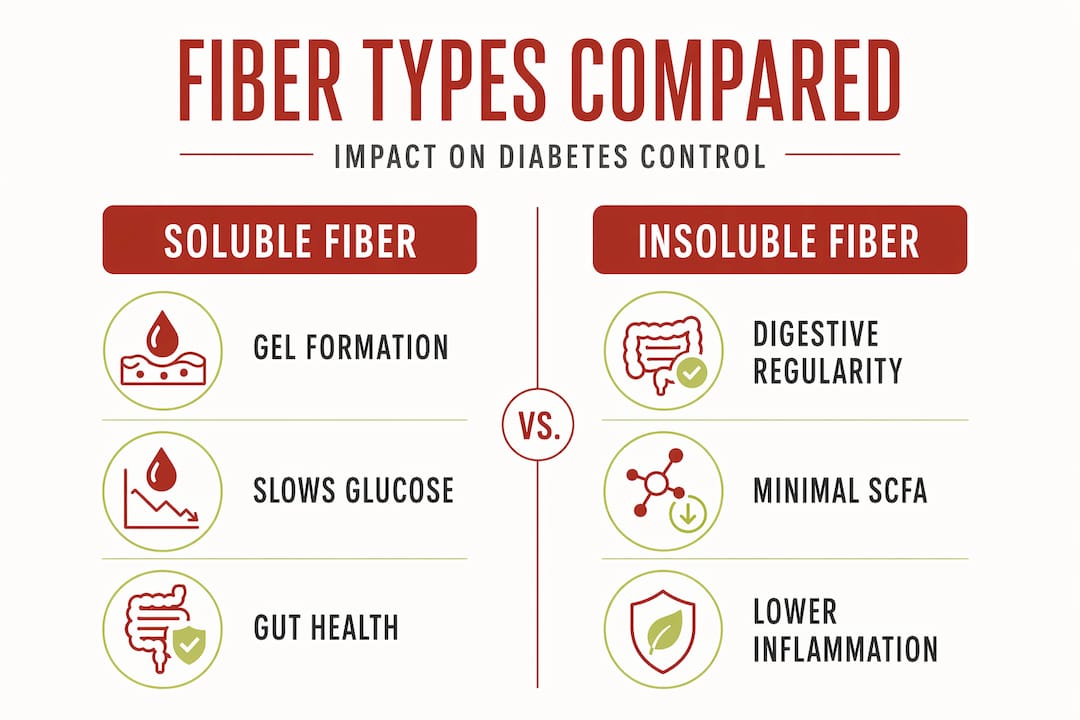
The distinction between soluble and insoluble fiber is not just academic. For diabetes management, these two fiber categories operate through different mechanisms and offer complementary benefits.
Soluble fiber dissolves in water and forms a viscous gel in the gut. This gel physically slows gastric emptying and the absorption of glucose into your bloodstream, blunting post-meal blood sugar spikes. A 2026 synthesis confirmed that soluble fibers reduce fasting glucose and HbA1c, and significantly dampen postprandial glucose spikes. Oats (beta-glucan), psyllium, barley, apples, and legumes are reliable sources. Most of the fermentable, SCFA-generating prebiotics fall into this soluble category.

Insoluble fiber does not dissolve or ferment as readily, so it doesn’t produce the same volume of SCFAs. Its benefits for insulin sensitivity operate through different pathways, including improvements in gut motility and possible effects on bile acid metabolism. The same 2026 evidence synthesis noted that insoluble fiber reduces the long-term risk of progression toward worse insulin resistance. Whole grain wheat, nuts, and vegetable skins are primary sources.
| Fiber type | Primary sources | Main mechanism | Diabetes benefit |
|---|---|---|---|
| Soluble (prebiotic) | Oats, barley, inulin-rich vegetables, legumes | Slows glucose absorption, ferments to SCFAs | Reduces HbA1c, fasting glucose, post-meal spikes |
| Insoluble | Whole wheat, bran, nuts, vegetable skins | Improves gut motility, bile acid metabolism | Reduces insulin resistance risk over time |
| Inulin-type fructans | Chicory root, Jerusalem artichoke, garlic, onion | Selective prebiotic fermentation by Bifidobacterium | Strongest direct evidence for glycemic benefit |
Understanding this comparison matters practically. If you’re choosing a fiber supplement to target blood sugar spikes, a viscous soluble fiber like psyllium or a standardized inulin product is more directly relevant than a wheat bran supplement.
Incorporating prebiotic fiber into a diabetes-friendly diet
Knowing that prebiotic fiber supports gut health and blood sugar regulation is only useful if you can actually build it into your daily life without GI discomfort derailing the effort. Here’s a practical sequence that works.
- Start with food, not supplements. Garlic, onion, leek, Jerusalem artichoke, chicory root, asparagus, and slightly underripe bananas are among the richest prebiotic fiber sources. Whole oats and barley provide both beta-glucan and fermentable fractions. Aim to incorporate at least two of these foods daily before reaching for a supplement.
- Increase intake gradually. The ISAPP recommends titrating fermentable fiber upward slowly to avoid bloating and gas. A sensible approach is adding 2 to 3 grams of additional fiber per week until you reach your target, typically 25 to 38 grams per day for adults.
- Consider a standardized prebiotic supplement. When food sources alone fall short, supplements standardized for inulin or FOS content offer a reliable, measurable dose. Look for products that specify the fiber type and the amount per serving.
- Pair fiber with adequate hydration. Soluble fiber requires water to form the gel that slows glucose absorption. Dietary fiber intake is notably less effective when fluid intake is low, a detail frequently missed in generic advice.
- Diversify your fiber sources. Diverse fiber intake supports microbiome diversity, which is associated with better metabolic health. Rotating your prebiotic foods prevents over-reliance on a single bacterial pathway.
- Monitor your glycemic response and adjust. Keep a basic log of your fasting glucose readings alongside your fiber intake for the first 90 days. This gives you real data to work with rather than relying on assumptions.
Reading food labels accurately is another skill worth developing. If you want a practical framework for spotting fiber content and total carbohydrate data on packaging, this diabetes food label checklist is a useful reference.
Pro Tip: Cooking and then cooling high-starch foods like potatoes or rice before eating them increases their resistant starch content, which behaves similarly to prebiotic fiber in the gut. It’s a low-effort way to add fermentable substrate to meals you’re already preparing.
Current limits of the science and where it’s heading
The clinical evidence for prebiotic fiber in diabetes management is genuinely promising, but it’s not yet mature enough to support rigid prescriptions. Acknowledging those limits isn’t pessimism. It’s scientific honesty.
Current trials vary widely in the fiber types tested, the doses used, the duration of interventions, and the populations studied. Most are also too short, typically under 12 weeks, to capture the full arc of microbiome adaptation. Longer-term studies are needed, and multi-omics clinical trials that integrate microbiome profiling, metabolomics, and glycemic tracking are just beginning to emerge.
There’s also the question of how prebiotic fiber interacts with medications commonly used in diabetes management. Metformin independently reshapes gut microbiota composition. GLP-1 receptor agonists alter gastric motility. Whether combining these therapies with targeted prebiotic supplementation produces additive or unexpected effects is still being investigated.
The most compelling emerging direction is precision nutrition: using baseline microbiome and metabolic profiling to predict who will benefit from which fiber type and at what dose before the intervention begins. This moves prebiotic fiber from general dietary advice to a genuinely targeted therapeutic tool.
The individual variability in fiber response observed in recent trials is likely a feature, not a bug. It signals that microbiome-guided fiber selection could one day rival pharmacological approaches in specificity, without the side effect profile.
My take on prebiotic fiber and diabetes
I’ve read a significant volume of clinical research on nutrition and diabetes over the years, and prebiotic fiber is one of the areas where I see the most honest tension between genuine promise and oversimplification. The “eat more fiber” message isn’t wrong. It’s just incomplete.
What I find consistently underemphasized is the adherence reality. Most people increase fiber intake, experience bloating within days, and abandon the effort before their microbiome has time to adapt. This gives fiber an unfair reputation for not working when the problem is almost always the rate of introduction, not the fiber itself.
I’m also cautious about the one-size-fits-all framing I see in most diabetes nutrition content. The cluster-based research showing that only certain microbiome profiles benefit meaningfully from fiber interventions is among the most practically important findings in this space. If your gut bacteria population is dominated by strains that don’t ferment inulin efficiently, adding chicory root daily won’t move your HbA1c.
My honest recommendation: treat prebiotic fiber as a long game. Track your markers. Work with your healthcare provider. And consider that gut health and heart disease risk share overlapping pathways, which means the gut-heart connection you’re supporting through fiber may offer broader metabolic protection than blood sugar alone.
The people I’ve seen get the most out of dietary prebiotic strategies are those who combine them with lifestyle changes and supportive supplementation rather than treating fiber as a standalone fix.
— Larry
How Tryrevivify supports metabolic and cellular health

Dietary prebiotic fiber creates the conditions for better gut health. At Tryrevivify, we’ve built on that foundation with a formulation that goes deeper at the cellular level. Our patented daily supplement, Revivify, combines prebiotic fiber with superoxide dismutase (SOD), an antioxidant enzyme that neutralizes free radicals at the cellular level before oxidative damage accumulates.
For anyone managing diabetes, oxidative stress is a real and persistent concern. Elevated blood sugar accelerates free radical production, which compounds inflammation and accelerates cellular damage. Revivify addresses this from two angles simultaneously: the prebiotic fiber supports your gut microbiome and SCFA production, while the SOD component targets systemic oxidative stress. If you want to explore how this dual-action formula fits into a metabolic health approach, take a look at the Revivify 30-day supply and see what a cellular-level approach to daily health looks like.
FAQ
What makes prebiotic fiber different from regular dietary fiber?
Prebiotic fiber must selectively feed beneficial gut bacteria and produce a demonstrated health benefit to qualify as a prebiotic. Not all fermentable fibers meet this standard, according to ISAPP’s expert consensus definition.
How does prebiotic fiber help with blood sugar regulation?
Prebiotic fiber is fermented by gut bacteria into short-chain fatty acids like butyrate and propionate, which improve insulin sensitivity, reduce inflammation, and help regulate hepatic glucose output.
Can prebiotic fiber replace diabetes medication?
No. Clinical evidence shows prebiotic fiber produces modest glycemic improvements that complement, but do not replace, prescribed diabetes medications. Always consult your healthcare provider before making changes to your treatment plan.
How long does it take to see benefits from prebiotic fiber?
Meaningful microbiome shifts and glycemic changes typically require at least three months of consistent intake. Monitoring HbA1c and fasting glucose over that window gives the most reliable picture of individual response.
Which prebiotic fiber sources are best for people with diabetes?
Inulin-type fructans, found in chicory root, Jerusalem artichoke, garlic, and onion, have the strongest direct clinical evidence for glycemic benefit. Beta-glucan from oats and barley is a strong second choice for managing post-meal glucose spikes.