

Lactobacillus vs Bifidobacterium: What Each Actually Does
Lactobacillus and Bifidobacterium are not competitors. They are two different specialists working two different shifts in your gut, and the honest, evidence-based answer to “which is better” is that neither one wins outright. Lactobacillus dominates your small intestine and produces lactic acid that keeps pH low and pathogens in check, while Bifidobacterium rules the large intestine and generates short-chain fatty acids that feed your gut lining. If your goal is broad digestive and immune support, a well-formulated product with both genera almost always beats a single-strain approach.
Here’s the short version before we get into the mechanisms and the clinical data:
- Lactobacillus is your go-to for antibiotic-associated diarrhea, vaginal microbiome support, and general small-intestine balance.
- Bifidobacterium is the stronger evidence pick for constipation, IBS symptom relief, and gut-barrier reinforcement.
Pro Tip: If you’re only going to remember one thing from this article, remember this: strain matters more than genus. “Lactobacillus” on a label tells you almost nothing about clinical performance. “Lactobacillus rhamnosus GG” tells you a lot.
Key Takeaways
Lactobacillus and Bifidobacterium succeed as complements, not competitors, because each colonizes a different gut region and produces different metabolites that support distinct health outcomes.
| Point | Details |
|---|---|
| Different gut real estate | Lactobacillus favors the small intestine; Bifidobacterium dominates the large intestine, so together they cover more ground. |
| Strain ID beats genus name | Look for full strain identifiers like L. rhamnosus GG or BB-12 rather than trusting genus-only labels. |
| Benefits fade without consistency | Colonization is largely transient, so daily intake matters more than occasional high doses. |
| Caution for high-risk groups | Immunocompromised or critically ill patients should consult a physician before starting any probiotic. |
| Combine with prebiotic fiber | Products like Tryrevivify pair prebiotic fiber with lactobacillus and antioxidant support for broader daily cellular and digestive benefit. |
This article is general information, not a substitute for advice from a qualified doctor. Consult a qualified healthcare professional about your own circumstances before acting on anything here.
Table of Contents
- Lactobacillus vs Bifidobacterium: The Core Comparison
- How Do Lactobacillus and Bifidobacterium Actually Work?
- What Does the Clinical Evidence Actually Show?
- How Should You Choose a Probiotic Strain or Product?
- Who Should Be Cautious With Probiotics?
- Should You Take Lactobacillus and Bifidobacterium Together?
- Why This Comparison Matters to Us at Tryrevivify
- Our Take: Stop Asking Which Genus Wins
- A Practical Next Step for Combined Gut and Cellular Support
- Sources
Lactobacillus vs Bifidobacterium: The Core Comparison
The fastest way to understand these two genera is to think about real estate. Lactobacillus species largely set up shop in your small intestine and mouth, tolerating some oxygen exposure and thriving in an environment with more nutrients passing through quickly. Bifidobacterium species are strict anaerobes that colonize your large intestine, where oxygen is nearly absent and the food supply is whatever fiber survived digestion further up the line. This isn’t a minor technicality. It’s why the two genera specialize in different jobs, according to a 2025 Nature review of gut microbiome colonization niches.
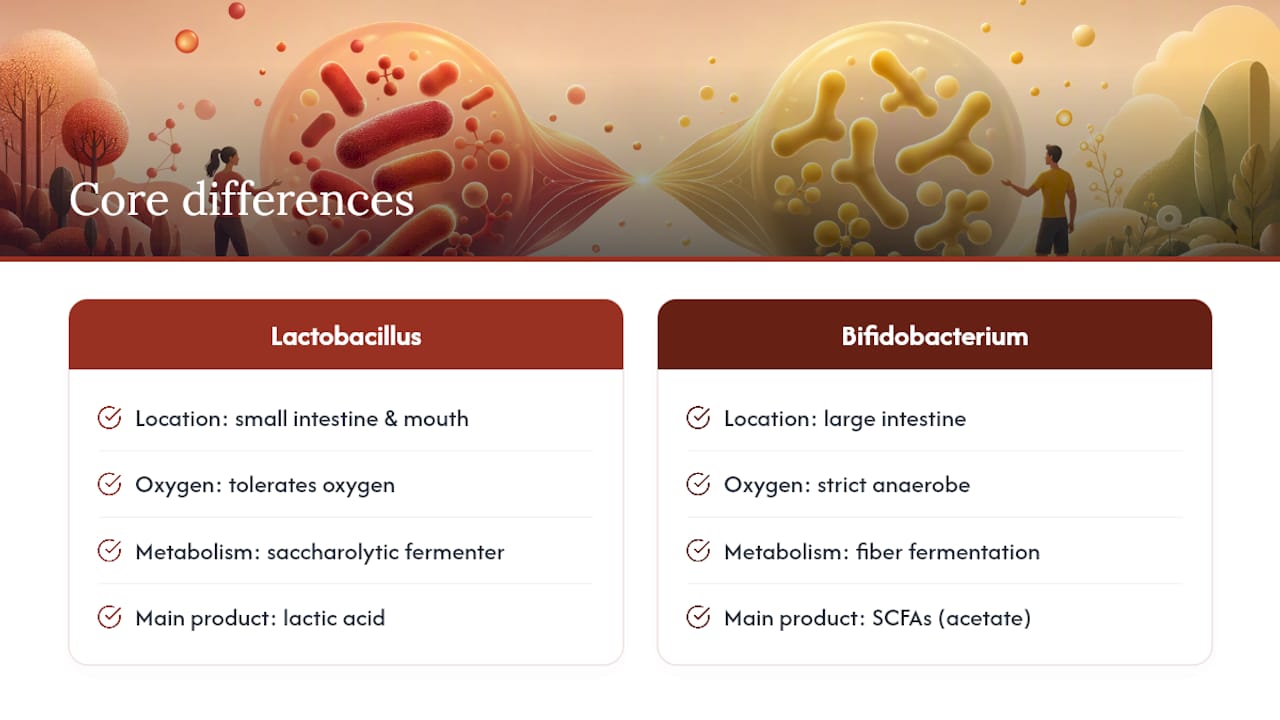
Metabolically, the split is just as clear. Lactobacillus strains are saccharolytic fermenters that produce lactic acid as their primary output, which lowers local pH and makes the environment inhospitable for many opportunistic pathogens. Bifidobacterium strains lean toward short-chain fatty acid (SCFA) production, particularly acetate, which feeds colon cells directly and helps maintain the integrity of your gut barrier.
Where each genus tends to show up in clinical use
Lactobacillus shows up most often in research tied to:
- Antibiotic-associated diarrhea prevention
- Adjunct therapy alongside H. pylori treatment
- Vaginal and urogenital microbiome support
- General lactose digestion and small-intestine balance
Bifidobacterium shows up most often in research tied to:
- Chronic constipation and bowel regularity
- IBS symptom management
- Gut barrier support and SCFA-linked benefits
- Early-life and infant gut colonization
Formulation matters here too, and it’s an underappreciated wrinkle. Bifidobacterium species are more oxygen-sensitive than most Lactobacillus strains, which means they often need tighter manufacturing controls, protective coatings, or refrigeration to survive shelf storage and stomach acid. A compendium on Bifidobacterium-based probiotics notes that species in this genus are recognized for raising SCFA levels that support barrier integrity and regularity, but that benefit only materializes if the organisms survive long enough to reach the colon alive.
This is the practical reason multi-genus formulas have become the default recommendation in a lot of clinical thinking. Combining Lactobacillus and Bifidobacterium covers two different gut regions, two different metabolic pathways, and two different sets of clinical endpoints in a single product. You’re not choosing a side. You’re covering more territory.
How Do Lactobacillus and Bifidobacterium Actually Work?
The differences between lactobacillus and bifidobacterium become a lot more meaningful once you understand the mechanics behind them, because the labels on a supplement bottle only hint at what’s happening at the cellular level.
Bifidobacterium’s signature move is cross-feeding. As these bacteria break down fiber your body can’t digest on its own, they release SCFAs, mainly acetate, that other gut microbes and your own colon cells can use as fuel. Butyrate, one of the resulting SCFAs, is the primary energy source for the cells lining your colon, and adequate butyrate supply is tied to a healthier, tighter gut barrier. Think of Bifidobacterium as a relay runner that hands off usable energy to the next runner in line, whether that’s a neighboring bacterial species or your own intestinal lining.

Lactobacillus plays a different game entirely. Its lactic acid output does double duty: it lowers local pH enough to suppress many pathogenic and opportunistic organisms, and several strains also produce bacteriocins, which are small antimicrobial peptides that directly interfere with competing bacteria. This is part of why Lactobacillus strains show up so often in vaginal health research. A lower, more acidic pH environment is a hostile one for the bacteria and yeast species associated with common imbalances.

Both genera also interact with your immune system, though the effects are strain-dependent rather than universal. Some strains promote regulatory T-cell (Treg) activity, which helps tone down inappropriate inflammatory responses. Others shift cytokine production in ways that support a more balanced immune posture. A 2025 review in Foods on Lactobacilli-mediated immune regulation points out that lactobacilli influence the microbial-immune axis through metabolites and cell-surface components, and the review’s authors specifically recommend combining genera for broader functional coverage rather than relying on one alone.
Statistic Callout: Most probiotic strains, from either genus, do not permanently establish themselves in your gut. Research on probiotic colonization and persistence indicates that benefits typically fade once supplementation stops, which is why consistency, not a one-time course, drives results.
Pro Tip: Don’t think of probiotics as a renovation you do once. Think of them as a maintenance crew that shows up while you keep paying them. Skip the daily dose long enough, and your resident gut flora reasserts its old patterns.
That transience isn’t a flaw in the science. It reflects the reality that your gut is already a densely populated ecosystem, and a daily dose of outside bacteria is competing for space and resources against trillions of residents that got there first.
What Does the Clinical Evidence Actually Show?
Strain specificity is the single most important idea in this entire comparison, and it’s the one most marketing copy glosses over. A 2025 compendium of Bifidobacterium-based probiotics makes the point directly: strain-level evidence, not genus-level assumption, is what should guide product selection.
Lactobacillus rhamnosus GG is probably the single most studied probiotic strain in the world, and it has consistent randomized controlled trial support for preventing antibiotic-associated diarrhea, particularly in pediatric populations. It also shows up in research on general digestive resilience and, in some studies, as an adjunct alongside standard H. pylori eradication therapy, where it appears to reduce treatment-related gastrointestinal side effects rather than replace antibiotics outright.
Lactobacillus acidophilus is one of the older, more commercially familiar strains, commonly included in fermented dairy and broad-spectrum probiotic blends. Its evidence base leans toward general digestive comfort and some vaginal microbiome studies, though the trial quality varies more than it does for L. rhamnosus GG, underscoring why strain-specific citations matter more than brand reputation.
Bifidobacterium animalis subsp. lactis BB-12 is arguably the Bifidobacterium equivalent of L. rhamnosus GG in terms of documentation depth. A 2025 Frontiers review dedicated to BB-12 describes it as one of the most extensively studied Bifidobacterium strains, with consistent trial support for improving bowel regularity, and notes it carries GRAS (Generally Recognized As Safe) status in the United States.
Bifidobacterium longum shows up frequently in research tied to IBS symptom relief and gut barrier support, with some studies exploring its role in modulating stress-related gut sensitivity, though this area still needs more large-scale confirmation before firm claims are warranted.
Strain-level evidence is essential because genus-wide claims routinely paper over enormous variability. Two products can both say “Lactobacillus” on the label and deliver completely different clinical outcomes, because the actual organism, the dose, and the delivery format are nothing alike.
The honest caveat across all of this: heterogeneity in trial design, dosing, and population makes cross-study comparison messy. A strain that performs well in one clinical population (say, hospitalized pediatric patients on antibiotics) doesn’t automatically generalize to a healthy adult managing occasional bloating. That’s not a reason to dismiss the evidence. It’s a reason to match the strain to the specific condition rather than assuming any probiotic will do.
How Should You Choose a Probiotic Strain or Product?
Reading a probiotic label properly is a skill, and most shoppers never learn it because most labels are designed to be skimmed, not scrutinized. Here’s the sequence that actually matters:
- Look for the full strain identifier, not just the genus and species. “Lactobacillus rhamnosus GG” or “Bifidobacterium animalis subsp. lactis BB-12” tells you something verifiable. “Lactobacillus” alone tells you almost nothing.
- Check for CFU count guaranteed at expiration, not at the time of manufacture. Bacterial counts decline over shelf life, and a product that only states CFU “at time of manufacture” may deliver a fraction of that number by the time you take it.
- Confirm third-party testing. Independent verification of potency and purity separates products that back their claims from products that just print a number.
- Ask whether the strain has trial citations behind it. A 2025 MDPI review on probiotic application and challenges makes the point bluntly: not all commercial products reliably deliver live, active, strain-validated bacteria, and survivability data is what separates the credible ones.
- Check storage instructions and follow them. Refrigerated strains that get left in a hot car or a sunny kitchen window can lose viability well before the printed expiration date.
Pro Tip: If a label lists five or more strains but no CFU count and no trial citation for any single one, treat that as a red flag rather than a feature. Breadth on a label is not the same as evidence behind the product.
Single-strain clinical products make sense when you have a specific, well-documented target. If you’re trying to prevent antibiotic-associated diarrhea during a course of treatment, a product built specifically around L. rhamnosus GG, dosed at the level used in the trials that support it, is a more defensible choice than a 20-strain blend with unclear individual dosing. If bowel regularity is your primary concern, a product centered on BB-12 has a stronger direct evidence trail than a generic “digestive support” blend.
Broad multi-strain blends make more sense when your goal is general maintenance rather than treating a specific, named issue. Because Lactobacillus and Bifidobacterium occupy different gut regions and run different metabolic processes, a combination formula covers more physiological ground than either genus alone, provided the product is transparent about what it actually contains and at what dose.
Who Should Be Cautious With Probiotics?
For the overwhelming majority of healthy adults, probiotics from either genus carry a well-established, low-risk safety profile. A PMC review comparing probiotic lactobacilli and bifidobacteria confirms that both genera are non-spore-forming, lactic-acid producing organisms with generally favorable safety records across human clinical trials, and that adverse event rates in healthy populations are low.
The exceptions matter, though, and they cluster around a specific risk profile rather than being random:
- Severely immunocompromised patients face a small but real risk of bacterial translocation, where live organisms move beyond the gut into the bloodstream.
- Patients with central venous catheters or other indwelling medical devices carry elevated risk because those devices can serve as an unintended entry point for bacteria.
- Critically ill patients in intensive care settings have shown rare cases of probiotic-related bloodstream infections in the clinical literature, which is why probiotic use in ICU settings is typically a medical decision, not a self-directed one.
Statistic Callout: Adverse events tied to probiotic use in healthy adult populations are rare across the clinical evidence comparing both genera, with meaningful risk concentrated almost entirely in severely immunocompromised or critically ill patients rather than the general population.
If you’re on immunosuppressive medication, recovering from major surgery, managing an active central line, or dealing with a serious acute illness, talk to your physician before adding any probiotic, regardless of genus. Mild, temporary bloating or gas in the first few days of a new probiotic regimen is common and usually resolves on its own. Persistent fever, unusual pain, or signs of infection after starting a probiotic are not something to wait out. That warrants a call to your doctor.
Should You Take Lactobacillus and Bifidobacterium Together?
For most people chasing general digestive and immune support, yes. The clinical rationale isn’t just theoretical convenience. It’s rooted in the fact that these two genera occupy different real estate and run different biochemical processes, so combining them covers more ground than doubling down on one alone.
Here’s how to actually put that into practice:
- Pair your probiotic with prebiotic fiber. Certain fibers, including inulin and xylooligosaccharides (XOS), preferentially feed Bifidobacterium strains and can boost SCFA output, according to the BB-12 review in Frontiers. A resource like Tryrevivify’s breakdown of prebiotics versus probiotics is worth a read if you want the fuller picture on why the two work as a pair.
- Take probiotics around meals, not always on an empty stomach. Food helps buffer stomach acid, improving survival odds for acid-sensitive strains, particularly Bifidobacterium.
- Respect the storage instructions. Shelf-stable, enteric-coated capsules are engineered to survive stomach transit without refrigeration. Refrigerated strains need to actually stay refrigerated to hit their labeled CFU count.
- Give it real time. Clinical trials generally run four to eight weeks before measuring outcomes like bowel regularity or symptom scores. Expect a similar window before you draw conclusions, not three days.
- Track something specific. Bowel frequency, bloating severity, or a symptom log gives you a real signal of whether the regimen is working, rather than a vague sense of “feeling better.”
Pro Tip: If you don’t notice a change after eight weeks at a consistent dose, that’s useful information too. It may mean the strain doesn’t match your specific issue, not that probiotics as a category failed you.
Most human trials on these genera use doses in the range of 1 to 10 billion CFU daily, though some clinical protocols for specific conditions run higher. Because benefits fade without ongoing use, as research on colonization persistence confirms, daily consistency matters more than occasional high-dose bursts.
Why This Comparison Matters to Us at Tryrevivify
At Tryrevivify, we approach the gut microbiome as one piece of a larger cellular health picture, which is why our formula pairs prebiotic fiber with lactobacillus rather than treating either in isolation. Prebiotic fiber gives resident and supplemented bacteria something to actually ferment, which is a meaningful piece of why strain survivability and SCFA output matter so much in the research above.
A few things we think are worth being upfront about:
- Our formula combines superoxide dismutase, prebiotic fiber, polyphenols, and lactobacillus in a single patented gel format, built around the idea that antioxidant support and gut support are connected, not separate problems.
- Tryrevivify is third-party tested and plant-based, and it’s backed by a risk-free guarantee for anyone who wants to try it without locking into a long commitment.
- We’re not claiming our formula is a substitute for strain-specific clinical products aimed at a diagnosed condition. It’s built as daily, broad-spectrum support.
Larry, the author of this piece, has spent years covering supplement science and cellular health for Tryrevivify’s editorial team, with a focus on translating peer-reviewed probiotic and antioxidant research into guidance readers can actually use.
Our Take: Stop Asking Which Genus Wins
Here’s what the research actually supports, and it’s less exciting than a clean winner: asking whether Lactobacillus or Bifidobacterium is “better” is the wrong question. It’s like asking whether your immune system or your digestive system matters more. They’re not competing systems. They’re doing separate jobs, and the evidence for combining them is stronger than the evidence for picking a side.
Where I think conventional advice falls short is the obsession with genus-level claims on packaging. A label that just says “Lactobacillus” is functionally closer to a marketing term than a clinical one. The strain is the unit that matters, and most shoppers have never been told to look for it.
If you take one thing from this comparison, prioritize the strain ID and the CFU-at-expiry number before you prioritize the brand name or the price. Everything else, including whether to combine genera or go single-strain, follows from getting that first decision right.
— Larry
A Practical Next Step for Combined Gut and Cellular Support
If you’ve read this far, you already understand something most probiotic shoppers miss: gut support and cellular support aren’t separate categories, they’re connected systems. That’s the exact gap Tryrevivify’s formula is built to close, pairing prebiotic fiber with lactobacillus and a patented superoxide dismutase blend in one daily gel, instead of asking you to juggle a probiotic capsule, a fiber supplement, and an antioxidant separately.

The prebiotic fiber in our formula is there for a specific reason: it gives lactobacillus and your existing gut flora something to actually ferment, which is the mechanism behind the SCFA production and pH benefits covered earlier in this article. We combine that with superoxide dismutase and polyphenols to address oxidative stress at the cellular level, rather than treating gut health and antioxidant support as two separate purchases. Tryrevivify is third-party tested, plant-based, and comes with a risk-free guarantee, with subscription options if you decide daily use fits your routine. If a combined antioxidant and prebiotic approach sounds like the missing piece in your current regimen, check out Tryrevivify’s daily formula and see whether it fits into your next order.
Sources
- Compendium of Bifidobacterium-based probiotics: characteristics and therapeutic impact on human diseases
- Lactobacilli-mediated regulation of the microbial–immune axis: key mechanisms and applications (Foods, 2025)
- Understanding the probiotic health benefits of Bifidobacterium animalis subsp. lactis, BB-12™ (Frontiers, 2025)