

The Role of Cellular Health in Blood Pressure
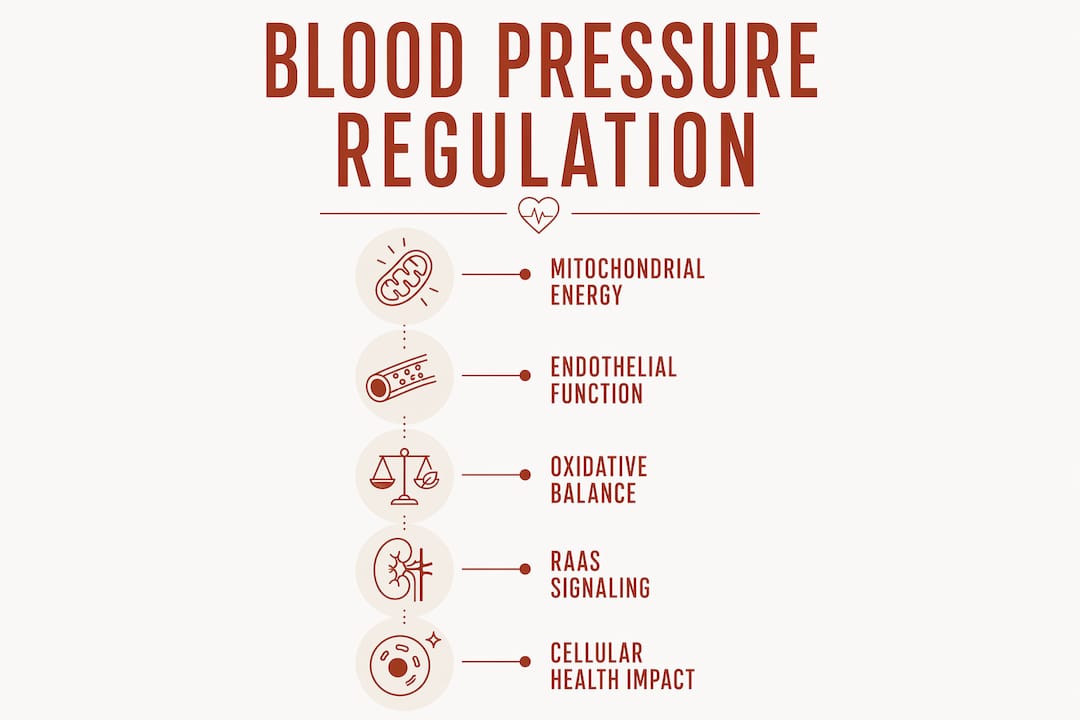
Cellular health is defined as the functional integrity of the body’s cells, and it directly determines how well your cardiovascular system regulates blood pressure. The role of cellular health in blood pressure control runs through three core mechanisms: mitochondrial energy production, endothelial cell function, and oxidative stress balance. When any one of these breaks down, your blood vessels lose the ability to relax and contract properly. Understanding how these cellular processes translate into systemic blood pressure outcomes gives you a far more useful framework than simply tracking sodium intake or stress levels.
How does cellular health affect blood pressure?
Blood pressure regulation is not a single-switch system. It depends on a continuous conversation between your cells, your blood vessels, and your hormonal signaling networks. Endothelial cells, the thin layer lining every blood vessel, produce nitric oxide (NO), a molecule that signals smooth muscle to relax and widen the vessel. When these cells are healthy, NO flows freely and blood pressure stays in a normal range. When cellular stress accumulates, that signal breaks down and vessels tighten.
Mitochondria sit at the center of this process. They generate the ATP that powers endothelial and smooth muscle cell function, and they regulate calcium signaling that controls vascular tone. The RAAS hormonal signals and cellular oxidative pathways work on different timescales but together shape sustained blood pressure control. RAAS acts in seconds; mitochondrial and endothelial dysfunction accumulates over months and years. That layered biology is why blood pressure problems are so persistent once they develop.

How mitochondrial function impacts blood pressure regulation
Mitochondria do far more than produce energy. They regulate reactive oxygen species (ROS), manage intracellular calcium, and control whether a cell survives or enters a dysfunctional state. A 2026 review in Functional & Integrative Genomics identifies mitochondria as central regulators of redox balance, calcium signaling, and cell survival, all directly linked to blood pressure control.
When mitochondria malfunction, three specific problems drive hypertension:
- Elevated ROS production. Damaged mitochondria leak excess free radicals into the cell, consuming NO before it can signal vasodilation.
- Impaired mitophagy. The cell’s system for clearing damaged mitochondria slows down, allowing dysfunctional units to accumulate and worsen oxidative output.
- Disrupted calcium signaling. Calcium dysregulation in vascular smooth muscle cells causes them to contract inappropriately, raising vascular resistance.
Mitochondrial dysfunction drives hypertension through all three of these pathways simultaneously. That overlap explains why addressing only one factor rarely produces lasting results.
Lifestyle factors that directly support mitochondrial health include aerobic exercise, caloric balance, adequate sleep, and reduced exposure to environmental toxins. Each of these reduces the oxidative load on mitochondria and preserves their ability to regulate vascular tone.
Pro Tip: Aerobic exercise, even 30 minutes of brisk walking five days a week, measurably improves mitochondrial density in vascular tissue. This is one of the most direct lifestyle levers you have for supporting healthy blood pressure at the cellular level.
What is endothelial cell senescence and why does it matter?
Endothelial cells are the gatekeepers of vascular relaxation. They produce nitric oxide through an enzyme called eNOS (endothelial nitric oxide synthase), and that NO diffuses into smooth muscle to trigger vasodilation. When endothelial cells become senescent, meaning they stop dividing and shift into a pro-inflammatory state, eNOS activity drops and blood vessels lose their ability to relax on demand.
A 2026 Nature Communications study identified the specific molecular pathway driving this process in obesity: NF-κB activation triggers microRNAs that suppress both eNOS and SIRT1, a protein that normally protects endothelial function. The result is reduced NO bioavailability and a vascular environment that favors constriction over relaxation. This is not just a marker of dysfunction. The research frames endothelial senescence as a direct driver of hypertension.
MicroRNA-155 is one of the key players in this cascade. miR-155 suppresses eNOS and amplifies NF-κB signaling, creating a feedback loop that worsens both inflammation and blood pressure control. Understanding this pathway matters because it points to specific cellular targets, not just general inflammation.
Here is how endothelial senescence progresses in practical terms:
- Chronic oxidative stress or obesity triggers NF-κB activation in endothelial cells.
- NF-κB drives microRNA expression that silences eNOS and SIRT1.
- NO production falls, reducing the vasodilation signal to smooth muscle.
- Vascular resistance rises, and blood pressure climbs.
Pro Tip: SIRT1 activity is supported by caloric restriction and compounds like resveratrol found in grapes and berries. These are not miracle solutions, but they address a real molecular target in the endothelial senescence pathway.
Oxidative stress and reactive oxygen species in blood pressure control
Oxidative stress is the condition where ROS production outpaces the body’s antioxidant defenses. In the vascular context, the primary ROS source is NADPH oxidase, an enzyme family that generates superoxide as part of normal immune and metabolic signaling. The problem arises when this system is chronically overactivated.
Superoxide does not just damage cells directly. It reacts with NO to form peroxynitrite, a molecule that cannot trigger vasodilation. This chemical reaction is the core mechanism by which oxidative stress impairs NO bioavailability and drives hypertension. A 2026 MDPI study showed that deleting or inhibiting NOX1 (a specific NADPH oxidase isoform) improved endothelial function and lowered blood pressure in an obesity model. That finding confirms NADPH oxidase as a mechanistic target, not just a correlate.
The table below contrasts two approaches to managing oxidative stress in the context of blood pressure:
| Approach | Mechanism | Limitation |
|---|---|---|
| General antioxidants (Vitamin C, E) | Neutralize free radicals after formation | Do not address ROS source; limited vascular penetration |
| NADPH oxidase inhibition | Block superoxide production at the enzyme level | More targeted; reduces peroxynitrite formation directly |
| Superoxide dismutase (SOD) support | Converts superoxide to hydrogen peroxide before NO reaction | Addresses the specific ROS species that consumes NO |
Oxidative stress markers correlate negatively with nitric oxide levels in hypertensive nephropathy patients, confirming that the redox state of cells directly predicts vascular function. This is not a theoretical relationship. It shows up in measurable clinical data.
You can read more about how nitric oxide and oxidative stress interact in vascular health to understand why targeting the source of ROS matters more than simply adding antioxidants.
How does the RAAS system signal at the cellular level?
The renin-angiotensin-aldosterone system (RAAS) is the body’s primary hormonal mechanism for rapid blood pressure adjustment. Angiotensin II, the system’s main active molecule, has a circulating half-life under 60 seconds yet produces powerful effects on vascular resistance and fluid volume. That speed reflects how tightly the body monitors and adjusts blood pressure moment to moment.
At the cellular level, angiotensin II binds to AT1 receptors on endothelial and smooth muscle cells. This triggers several downstream effects:
- Vasoconstriction through smooth muscle calcium release
- Reduced eNOS activity, cutting NO production
- Increased NADPH oxidase activation, raising ROS output
- Stimulation of aldosterone release, promoting sodium and water retention
Each of these effects raises blood pressure through a different cellular pathway. Berberine, a compound found in plants like Berberis vulgaris, blocks AT1R signaling and restores AKT/eNOS activity in endothelial cells, improving vascular relaxation. A 2026 study in the Chinese Journal of Integrative Medicine confirmed this mechanism, showing berberine reverses angiotensin II-induced endothelial dysfunction at the molecular level.
The RAAS also illustrates why blood pressure is a multi-timescale problem. Angiotensin II acts in seconds, but the cellular remodeling from mitochondrial dysfunction and endothelial senescence unfolds over months. Effective support requires addressing both the fast hormonal signals and the slower cellular changes underneath them.
Key takeaways
Cellular health governs blood pressure through mitochondrial function, endothelial integrity, and oxidative stress balance, and all three must be supported together for lasting results.
| Point | Details |
|---|---|
| Mitochondria regulate vascular tone | Dysfunctional mitochondria raise ROS, disrupt calcium signaling, and impair NO-driven vasodilation. |
| Endothelial senescence drives hypertension | NF-κB-triggered microRNAs suppress eNOS and SIRT1, reducing the vasodilation signal in blood vessels. |
| NADPH oxidase is the primary ROS source | Superoxide from NOX enzymes consumes NO to form peroxynitrite, the key mechanism behind oxidative hypertension. |
| RAAS acts fast; cellular damage accumulates slowly | Angiotensin II signals in under 60 seconds, but mitochondrial and endothelial dysfunction builds over months. |
| Targeted approaches outperform general antioxidants | SOD support and AT1R-targeted compounds address specific ROS pathways that broad antioxidants cannot reach. |
Why simple fixes miss the point
Most conversations about blood pressure focus on sodium, stress, and medication. Those factors matter, but they sit on top of a much deeper cellular story. After spending years reading the research on vascular biology, what strikes me most is how the field has shifted. The 2026 studies on endothelial senescence and NADPH oxidase are not incremental updates. They identify specific molecular addresses where blood pressure dysfunction originates.
The uncomfortable truth is that general wellness advice, eat less salt, exercise more, take a multivitamin, does not reach those addresses. Mitochondrial dysfunction, eNOS suppression via miR-155, and peroxynitrite formation are not problems you solve with a generic supplement stack. They require approaches that respect the biology: supporting SOD activity to intercept superoxide before it consumes NO, reducing the oxidative load on mitochondria, and protecting endothelial cells from the senescence cascade.
What I find genuinely promising is that cellular health interventions targeting endothelial senescence may offer better long-term blood pressure control than acute symptom management alone. That is a meaningful shift in how we think about cardiovascular wellness. The goal is not just to lower a number on a cuff. The goal is to restore the cellular conditions that allow your vascular system to self-regulate. That takes time, consistency, and the right biological targets.
— Larry
How Tryrevivify supports cellular health for blood pressure wellness
At Tryrevivify, we built our formula around one of the most specific and underappreciated targets in vascular health: superoxide dismutase (SOD). SOD is the enzyme that converts superoxide into hydrogen peroxide before it can react with NO and form peroxynitrite. Think of it as the first runner in the antioxidant relay, catching the most damaging free radical before it disrupts vasodilation. Our patented formula combines SOD with prebiotic fiber to support bioavailability and systemic delivery, addressing oxidative stress at the cellular level where blood pressure regulation actually begins.

If you want to support your heart health at the cellular level, Tryrevivify gives you a research-grounded starting point. Explore the 30-day supply and see how targeted cellular support fits into your blood pressure wellness approach.
FAQ
How does cellular health affect blood pressure directly?
Healthy cells maintain nitric oxide production, mitochondrial energy output, and controlled ROS levels. When any of these break down, blood vessels lose the ability to relax properly and blood pressure rises.
What is the role of mitochondria in blood pressure regulation?
Mitochondria regulate ROS output, calcium signaling, and ATP production in vascular cells. A 2026 review in Functional & Integrative Genomics confirms that mitochondrial dysfunction drives hypertension through all three of these pathways.
What is endothelial senescence and how does it raise blood pressure?
Endothelial senescence is the process by which blood vessel lining cells shift into a pro-inflammatory, non-functional state. A 2026 Nature Communications study shows this suppresses eNOS and SIRT1, cutting nitric oxide production and promoting vasoconstriction.
Why do general antioxidants often fail to lower blood pressure?
General antioxidants like Vitamin C and Vitamin E neutralize free radicals after they form but do not block NADPH oxidase, the primary enzyme producing superoxide in vascular tissue. Superoxide dismutase (SOD) addresses the specific ROS species that consumes NO before vasodilation can occur.
What is the RAAS system’s role in cellular blood pressure control?
RAAS uses angiotensin II to rapidly adjust vascular resistance and fluid volume, with effects lasting under 60 seconds per cycle. At the cellular level, angiotensin II activates NADPH oxidase and suppresses eNOS, linking hormonal signaling directly to oxidative and endothelial dysfunction.